
If you search flying squirrel vs sugar glider, you will see two animals that look almost identical. Big eyes. Soft fur. A flap of skin between the legs. Both glide from tree to tree.
So are they the same?
No. They are completely different animals. They belong to different groups of mammals. They live on different continents. They reproduce in different ways.
If you run a wildlife blog, pet site, or follow Sugar Glider Facts, you need to know these differences clearly. Let’s break this down step by step.
Why People Confuse These Two Animals
Similar Body Shape
Both animals have a membrane called a patagium. This skin stretches between the front and back legs. When they jump, the membrane spreads like a parachute.
From a distance, they look the same.
Gliding Behavior
Neither animal flies. They glide.
They leap from trees and steer through the air. Some flying squirrels glide over 45 meters. Sugar gliders usually glide shorter distances, around 20 to 30 meters.
Nocturnal Lifestyle
Both are active at night. They have large eyes to see in low light.
This shared behavior adds to the confusion.
Flying Squirrel Overview
Scientific Classification
Flying squirrels are placental mammals. They belong to the rodent family. They are closely related to regular tree squirrels.
Habitat and Geographic Range
Flying squirrels live in North America, Europe, and parts of Asia.
Northern Flying Squirrel
The Northern Flying Squirrel lives in Canada and colder US regions. It prefers dense forests.
Southern Flying Squirrel
The Southern Flying Squirrel lives in the eastern United States. It tolerates warmer climates.
This matters when comparing sugar glider vs southern flying squirrel. Their habitats never overlap naturally.
Diet and Behavior
Flying squirrels eat:
• Nuts
• Seeds
• Fruits
• Fungi
• Insects
They are mostly solitary. They nest in tree cavities.
Sugar Glider Overview
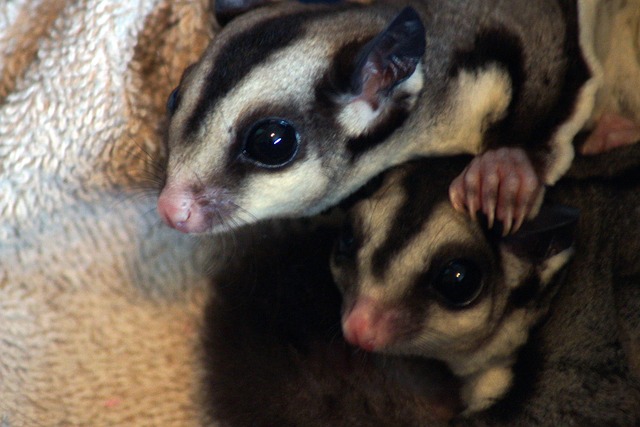
Scientific Classification
Sugar gliders are marsupials. They belong to the same broad group as kangaroos and koalas.
This is the biggest difference in the sugar glider marsupial vs flying squirrel debate.
Native Range
Sugar gliders live in Australia, Papua New Guinea, and Indonesia.
When you compare sugar glider vs flying squirrel range, you see zero natural overlap.
Diet and Social Structure
• Nectar
• Sap
• Insects
• Fruit
They live in social groups of up to 7 adults. They groom each other and vocalize often.
Pet owners learn this quickly. Sugar gliders need companionship.
At Sugar Glider Facts, we often highlight this social need because many new owners ignore it.
Flying Squirrel vs Sugar Glider Key Differences
Mammal Type, Placental vs Marsupial
Flying squirrels develop inside the mother with a placenta.
Sugar gliders give birth to tiny, underdeveloped young. The baby crawls into a pouch and continues developing there.
Reproduction and Development
Sugar glider babies, called joeys, stay in the pouch for about 70 days.
Flying squirrel babies develop fully inside the womb before birth.
Physical Traits
Flying squirrels:
• Larger flat tail
• Thinner fur
• Longer body shape
Sugar gliders:
• Thicker fur
• Dark stripe on head
• Curling tail tip
Lifespan
Sugar gliders in captivity live 10 to 15 years.
Flying squirrels in the wild live around 5 to 6 years.
Sugar Glider vs Flying Squirrel Convergent Evolution
What Convergent Evolution Means
Convergent evolution happens when two unrelated species develop similar traits due to similar environments.
How These Two Species Evolved Separately
Flying squirrels evolved gliding to escape predators and access food in forests.
Sugar gliders evolved the same adaptation in Australia.
They are not closely related. They evolved similar features independently.
This makes sugar glider vs flying squirrel convergent evolution a strong example used in biology textbooks.
Sugar Glider vs Flying Squirrel Range Comparison
Flying squirrels live in:
• North America
• Europe
• Asia
Sugar gliders live in:
• Australia
• Papua New Guinea
• Indonesia
If you see one in North America as a pet, it was imported.
Sugar Glider Marsupial vs Flying Squirrel Explained Clearly
Here is the simplest breakdown:
Flying squirrel equals rodent plus placental mammal.
Sugar glider equals marsupial plus pouch development.
If you remember this, you will never confuse them again.
Sugar Glider vs Southern Flying Squirrel
The Southern Flying Squirrel is smaller than the Northern species.
When compared to sugar gliders:
• Similar size
• Different reproduction system
• Different continents
• Different social behavior
Sugar gliders are more social. Southern flying squirrels are more independent.
Which One Makes a Better Pet
Sugar gliders are common in the exotic pet trade.
Flying squirrels are rarely kept and often require permits.
Before choosing, consider:
• Legal status in your country
• Veterinary availability
• Social needs
• Lifespan commitment
Sugar gliders require daily interaction. Ignoring them leads to stress behaviors.
At Sugar Glider Facts, we advise owners to research diet and enrichment before buying.
Final Thoughts
Flying squirrels and sugar gliders look alike. They glide. They are nocturnal.
But they belong to different mammal groups. They evolved separately. They live on different continents.
When someone searches flying squirrel vs sugar glider, they want a clear answer.
Now you have one.
FAQs
- Is a sugar glider a type of flying squirrel?
No. A sugar glider is a marsupial. A flying squirrel is a rodent. - Which glides farther?
Flying squirrels often glide farther distances than sugar gliders. - Do they live in the same country?
No. Their natural ranges do not overlap. - Are sugar gliders legal pets everywhere?
No. Laws vary by country and region. Always check local regulations. - Why do they look so similar?
They evolved similar gliding adaptations through convergent evolution.


